Showing posts with label Play Aid. Show all posts

08 August 2014

Earthdawn: Adventure Log 27 - Dark Heart

This is the twenty-seventh Adventure Log in an ongoing series about Earthdawn. Introduction and Index.

This is not a canon location.

Not all of the background and secrets of Ashwood Forest can be divulged since the characters may not yet be done with this place.

They have learned the forest is a place of power, inviolate to Horrors and those who bear their mark; at least, that is the claim. Though surveying astral space confirms it is completely free from their taint. Some who pass on to death come to reside in the forest, trapped as shades for reasons unknown, though there were a few theories put forth. The transformation into a mindless shade takes time and those who can resolve whatever keeps them in this place will pass on from it.

It has a bounty of natural resources, with true elements and living crystal forming within its borders. There are also plenty of natural dangers, not to mention the shades, to go along with this. Such is the draw for this place, the guardian related a story told to him by his predecessor that the war between Cara Fahd and Landis was fought over the forest and everything within it. There was some circumstantial evidence to support this of ancient battles outside of the borders where their airship had crashed.


Adventure Log – 027 Dark Heart

Written By: Coriolis of Travar

Date: 27 Rua – 30 Rua, 1508 TH
Group Name: Mismatched Steel

Group Members
Bongani the Scout
Coriolis the Swordmaster
Elmod the Nethermancer
Honeysuckle Sunspray the Windmaster
Ting the Swordmaster


We are currently in the Ashwood. This area is filled with spirits and mysteries. The guardian of this place cryptically tells us about the many dangers that await us in this place.

We now stand in a sea of ash trees without a solid plan on how to find the one tree we're looking for, so we turn to the spirits for advice. The forest spirits stand about 16 inches tall. They are curious little child-like things(1). Apparently they're also hungry things as well.

Ting showed them that they can eat our food during Elmod and my watch. They ate almost all of the food we had. Which means rather than focus on finding the tree, we now have to use our skills to find food and survive.

Growing up in Travar has taught little of wilderness survival. I talk to the forest guardian for help, hit while polite, he didn't offer much help. Luckily the rest of the group had a little bit more success than I did. Bongani came back to camp with enough food to get us through the day, but only one day.

Using the rest of the day light, we combined our efforts into a single hunting party. Our party came across three behemoths. Luckily, with Elmod's magic we were able to scare off the biggest of the beasts. The rest of the beasts quickly fell to my more blood thirsty companions. We harvest any useful bits off the beasts and head back to camp.

The next day, we leave foraging to Bongani and the rest of us forget the dangers of yesterday and set off, leaving the safety of numbers and traveling alone through the woods. Our solo adventures reveal the wealth of riches that is in the forest(2). The most interesting of these riches was the tree Elmod was looking for this whole time.

A group of shades seem to hang around the tree. Shades are small, Horror-like beings(3). Getting to this tree is going to be a problem.

That night our camp is visited by these shade creatures. We draw weapons for battle and Bongani works on restarting our fire. The fire lights before the blood bath can start. At the sight of the light, the shades recoil to the edge of the light. We don't pursue the confrontation and keep within the safety of the light until dawn breaks.

The next morning, we set off on our own adventures, but are quickly brought back together by the battle cry of Bongani. We ran together to find him set upon by five nightmares(4). Their coats were black as a moonless night. The battle was epic and there were many wounded on both sides. It was a hard fought battle, but we came out the victors.(5)

*     *     *
(1) We have no information on what this could be. The description is specific; refer to an Elementalist for more information and taxonomy.
(2) What kind of riches? Need details. 
(3) What is a shade? Again, this seems to be specific, but we have no records of anything like this; refer to a Nethermancer for more information and taxonomy.
(4) Are these literal nightmares given form, or yet another thing which we have no information about? Details, people, details!
(5) Received and edited by Ela Pono

Par for the course, there was a great deal left out here. Some is covered in the introduction, and a large portion regards the specifics on what they did and found each day. Everything left out of this log was a deliberate choice of the group. There were a great deal of specifics they did not want getting out. Including specific information about Ashwood Forest, the strange things which reside there (spirits and shades), the wealth and rarities which can be found within the borders, and the fact they murdered a herd of unicorns. Yeah, those were the "nightmares". To be fair, they were pre-Scourge unicorns who had been living with the forest for generations, untouched by the Horrors, one got away (though it did stalk them), and they only took a few of the horns to sell. If a few is all of them. Yes, the engaged in unicorn horn smuggling and ended up selling it all to their favorite Nethermancer in Bartertown, Fastoon.

From an actual session planning perspective, this was fairly intensive and allowed some of the less used abilities to have their day. It was pretty simple to have the group separate themselves from their supplies. Which was the first time they were far from a base of operations, in dangerous territory, with nothing to eat, or safe to stay. Wilderness Survival became incredibly useful. Though there is a bounty of life, much of it is strange and dangerous, making every expedition potentially dangerous. This also meant time had to be divided between staying alive and finding the secrets of the forest.

Which leads to the major feature of their time in the forest:


I created a bunch of envelopes (well over a hundred), each with an encounter of some kind within. The characters would set out into the forest and use some kind of ability to help them in their exploration. Each of the envelopes fell into a category, whether it was botanical in nature, an animal encounter, mystical, or random, and the ability used would dictate what category of envelope they drew from. Result level would give how many encounters they had in a given day.

Included in a number of the envelopes was the tree they were looking for, The Dark Heart. This was very popular with the players and caused them to make all kinds of terrible decisions which nearly resulted in their deaths; if you disappear into the forest alone, no one will be able to use a last chance salve on you. They spend significantly longer than they had probably intended in the forest, just exploring.

Some examples of encounters include:

Dead Ash: A black ash stands lifeless. There are no leaves or forest spirits in its branches.

Fruit of the Forest: Protruding from the trunk of a giant ash tree are nuggets of wood which appear exceptionally vibrant.

Massacre: A macabre scene happened here. There are eight bodies resembling bipedal wolves, slightly smaller than a human. Fur has been sloughed off in places, revealing long, black marks on their skin. The eyes have been plucked and their tongues torn out.

Message in a Bottle: Perched in the boughs of an ash tree is a very small scroll case. At the base of the tree is the corpse of an ork. They haven't rotted, but show some signs of being picked over by scavengers, black marks on their skin, and broken limbs. The scroll case contains some scraps of paper with cramped, but tidy, cryptic writing.

A Monument to... Something: A step pyramid has been constructed of skulls. They appear to be mostly human and ork, but all Namegivers seem to be represented. The ground in the surrounding area is torn up and a buzzing drone fills the air.

Unexpected Undergrowth: Around the base of an ash tree are protruding some small, green, opaque crystals. A bit of excavation reveals there is significantly more underground.

Unnatural Remains: A number of ash trees have grown around a large, otherworldly corpse. A single, pristine, white ash is growing through what would mostly likely be consider its "heart".

Those in the picture, which are ones they did not find, are:

Murder Scene?: A large swath of ash trees and undergrowth are brittle, dry, and dead. Eventually, you discover briar and wood in the shape of a woman with a long iron spike in "her" chest. her face has a look of terror and her body is frozen in pain.

Penny Lane: You come upon a lane of trees, black and white. Some have grown around copper-colored chains, others just starting. Some of the chains hold skeletons. Shades climb down the trees, faces contorted in pain, reaching out, stretching their long limbs and fingers.

A Tale of Two Kaers: A skeletal arm emerges from the trunk of an ash tree. Clenched in its bony fingers is a scroll case. Within the case are notes which imply the existence of two kaers located somewhere south of Jerris. The evidence is in the form of Theran supply logs, ancient letters to family members from a destroyed kaer in Landis (in Dwarf, not Throalic), and records of some news spread by Hugh Louis - famed pre-Scourge Troubadour.

Topo Berry: This black and pink berry is bitter and causes severe nausea in anything who consumes them for a day. Prolonged exposure can result in death.

The Wreckage of Stars: Scattered through this portion of the forest is the wreckage of a Theran kila. It has long been destroyed and overrun by the forest. There is a cemetery nearby, overgrown with ash trees, though the gravestones are untouched. 

13 June 2013

Earthdawn: Adventure Log 19 - Something Rotten in Scavia

This is the nineteenth Adventure Log in an ongoing series about Earthdawn. Introduction and Index.

The region that includes Scavia, just north of the Scarlet Sea, near the Badlands, is a place that my games almost always include at some point. There isn't much official written about that area, which might be part of the appeal. What is known is that the human kingdom of Scavia was once seated at the edge of the Scarlet Sea, an off-shoot of Death's Sea, it was wealthy and was one of the first governments to accept the Theran Rites of Protection and Passage. Oh, and the kaer was built on top of lava and the civilization itself resided on the ruins of something ancient. Those last two might have something to do with it.

While it wasn't actually overrun during the Scourge, I'm not against saying that it was because the idea of an opulent kaer with fantastic and sweeping architecture, built in the Scarlet Sea, partially flooded with lava, infested with creatures from the area along with whatever Horrors call it home is freaking awesome. If you don't like the idea of that, I don't think that I want to know you. I'm serious. It's hardly a low Circle endeavor, but it is definitely a location where you can craft some amazing encounters that you will never get another shot at. And if an entire people has to be sacrificed to entities that feed on fear and pain from beyond our reality, them's the breaks.

In the surrounding region, there is substantial opportunity for adventure. While the kaer itself is generally only good for one amazing arc, the rest of the area should be good for a few stories. Since I take a darker look at Barsaive as a whole, my setting generally has that area spotted with smaller kaers from the people of Scavia that were taxed and enslaved to provide for the magnificent kaer of the capital. Many of their kaers were constructed from the strange ruins that their society was built on, since they were on a budget. Some of these were great, others not so much.

Nonetheless, it was weird. Things got strange and it may or may not be related to the Badlands to the southeast. The survivors tend to be poor and xenophobic. They don't care for outsiders and generally lead very suspicious lives. Their insular natures make this a good place to introduce creepy cults formed around the runs-cum-kaers. The general feel I go for in this region is similar to the Midwest during the Dust Bowl. With a healthy dose of the Appalachians or Ozarks, giving a feel that they haven't quite joined "modern" society in a lot of ways.

Adventure Log – 019 Something Rotten in Scavia

Written By: Honeysuckle Sunspray of Glenwood Deep

Date: 01 Celebration – 12 Raquas, 1507 TH
Group Name: Mismatched Steel

Group Members
Elmod the Nethermancer
Honeysuckle Sunspray the Windmaster
Jak’Tak the Weaponsmith
Sogun the Messenger
Ting the Swordmaster


Our latest adventure has taken us to Scavia and the settlements surround the area. This settlement still requires visitors to prove they aren’t Horror marked, how quaint(1). They are rather strange and won’t let Ting stay in the inn(2). The innkeeper talked of a stranger passing through and the effects look as if this stranger was peddling krokodil(3).

Jak confirmed the location of the shop where the tainted drugs are being distributed. The distributer, Bracha, used to be the leader of the town. The whole area seems to be affected by the drugs.

In the evening we decide to be champions of justice and Sogun breaks down the door to the shop and picks up Bracha to stop the process of making krokodil. Bracha described a dark looking elf Named Mestoph(4) that was the distributer of this drug.

I know we’ve followed the dark trail of Mestoph before, still not sure of the connection between Elmod and Mestoph, but I know there’s one(5).

Meanwhile… back at the alchemy shop, Jak and Ting managed to destroy the tools to make the drug and are going to bury the remaining supply.

In the process we see a person, obviously hooked on krokodil. After two straight days of travel following this guy, we knock him out and tie him up so we can get some sleep. The next morning we release him to continue following him. Towns that we pass through are filled with beggars that are heavily addicted(6).

Finally, we reach broken down ruin that seem dark and nefarious. The inscription is written in Sperethiel and it sounds like there is a Horror trapped inside. Despite the evidence of mindless souls entering, we head inside(7).

Broken down buildings are seen and crazed laughter can be heard with no identifiable source. Once we looked closer, the mindless shapes began coming toward us and block our path in all directions. We managed to fight our way out, but Ting was poisoned, so we decided to head back.

Heading back, we meet a traveler in a wagon, Morlan, who sells things to adventurers at a mark-up, of course. Morlan is a Merchant adept who travels to find interesting wares and sell them in remote locations.

After spending all of our money, we decide to head back to the tainted ruins, possibly against better judgment. Elmod, in a creepy sort of way, talks to a ghost outside the city who seems to be guarding the city as there is a Horror trapped inside. We venture inside as sneaky as possible, but jehuthras spot us anyway. In true hero/adventurer fashion (survival mode) we run away to the interior of the city where we see a robed figure sitting on a throne.


He is surrounded by cadavermen and jehuthras and seems happy to see Elmod. He is really creepy with black skin, white hair and bright red veins. His throne grows around him, creating some sort of super body structure with four arms and a spiky tail(8).

There must be some crazy Horror magic in this place to create something so hideous. Destroying this creature is the only option. The animated armor is not easy to damage, but we were able to find some weak points and chip away at it until we finally destroyed the Horror tainted creature that caused this mess.

Perhaps in destroying him, the krokodil will be less of an issue in the surrounding camp areas. After saving the world once again, it is time to head somewhere a little less exciting.(9)


*     *     *
(1) The Greeting Ritual is very common outside of the major cities in Barsaive.
(2) Sounds like Ting is a little rusty with her art.
(3) We had no idea this had spread so far...
(4) This needs to be verified immediately. If the Mestoph is behind this... I don't even know.
(5) Additional intelligence needs to be gathered here.
(6) Maybe it has spread here from the South? Perhaps Maester Bleys is good for something after all.
(7) Hah! I love these guys. "Sounds dangerous and stupid to enter... what are we waiting for?"
(8) I would love to know more details about this. If nothing else than to make Zamrica read it.
(9) Received and edited by Ela Pono

There were three things going on in this session. The first involved showing the extent of the krokodil problem, that it wasn't just localized to Bartertown, but throughout at least parts of Barsaive. While they had encountered the drug previously, the Group never got to see what some of the other effects are. Beyond the disease and rotting of the skin, that is. There were less answers than new questions, but it was fairly clear this problem is even worse than it initially appeared in Bartertown.

The next element to this session was exploring more of Elmod's mysterious background. He learned that someone who looks almost exactly like him (just with polarized colors) was going by the assumed Name Mestoph, who Initiated Elmod into his Discipline, is involved with the krokodil problem in someway, as well as some very dark blood magic that he used to create some sort of blood magic mecha, and is almost certainly dealing with Horrors in some fashion. Oh, and he definitely knows who Elmod is and is pretty jealous of him. Why? Who knows - it's not like Elmod had a blood mecha. 

Finally, danger. The encounters this session were pretty serious - there weren't any lucky rolls to skew the results and what started as overconfidence turned into cautious determination. Which is precisely where I wanted the tension at for the big boss fight - the aforementioned blood mecha.

This was the first fight of its kind and I wanted the encounter to be as awesome as the initial promise: that you will be fighting an "evil" (?) mirror-universe twin-thing Nethermancer who has constructed a mecha from the meat and bones of the drug users that have been summoned to his corrupted lair in the bowels of a broken kaer. The environment itself had pools of blood at one end of the room, where the throne-cum-mecha was, and an arc of standing stones at the other end, where the PCs entered from. While the blood was never used, the stones provided some important, though deteriorating, cover during the fight.

While that is all well and good, the opponent is what really matters. It was well above anything they could have handled for a few more Circles. I'm pretty certain it would still be a challenge for them - but without that, there is no sense of accomplishment. No bones about it, this was a hell of a thing. It was just over 15 feet tall, a body somewhere between humanoid and beast. It had a massive bleached white skeleton that also acted as armor, with claws, a long, spiked tail, and a gaping maw. Underneath the skeleton was glistening muscle, sinew and tendons, with living crystal growing from that mass as additional armor and to serve other, unknown purposes. The Nethermancer himself was within the rib cage, nestled in the protective womb of bone, crystal and muscle where he controlled and powered the thing by binding it to most of his spell matrices, along with Thread Magic. 

Actually, here it is:

DEX: 8   STR: 18   TOU: 13   PER: 9   WIL: 9   CHA: 5

Initiative: 10
Actions:  4 + 1 (4 physical actions, one Spellcasting/Thread Weaving)
Attack (8): 16
Damage:
Bite (7): 25
Claws x2 (2): 20
Tail (3): 21 ( Armor Defeating on a Good Result)

Physical Defense: 14
Spell Defense: 10
Social Defense: 12
Physical Armor: 20 (Armor Defeated on an Excellent Result)
Mystic Armor: 10 (Armor Defeated on an Excellent Result)

Death: 150
Unconsciousness: (I'm going to be honest, I didn't bother)
Wound Threshold: 15
Recovery Tests: 3
Knockdown: 19
Movement: 10

Karma Points: 10     Karma Step: 4

Powers: Astral Spear (7): 16, Battle Bellow (4): 9, Spellcasting (6): 15, Thread Weaving (6): 15, there are plenty more powers, but I just didn't feel like trotting them out since I wanted all of this to fix on an index card

How were they possibly supposed to defeat this monster? Teamwork. No, seriously, through teamwork. The first round on combat was the PCs attacking while it was "coming online", giving them a chance to figure out just how screwed they were unless something changed in their favor.

When I have something neat planned, I've learned the hard way that it's best to not hope the players are going to randomly stumble into it, unless you absolutely know they will. In this case, I didn't wait for anyone to ask, "Does it look like there are any weak points?" There is no way for me to know if they will (they never have before, but they have never had to) and it's not like Earthdawn has any support one way or the other, it's very much up to the GM. So, after they roll initiative for the next round, I ask who wants to make a Perception Test as a Simple action for 1 Strain. They could do it as a Standard action for no Strain as well. Suffice to say, they were curious.

At that point, I introduced the Weak Points (while prototypes are generally regarded as super awesome, they also have the super downside of falling apart). These were some index cards that had a particular maneuver on it (Cutting the Tendons), along with the requirements (Called Shot, Physical Defense 10, at least 12 damage) and the effects (reduce Physical Defense and Initiative by 2). There were a variety of them, each affecting some part of the nethermecha, with some crossover - physical attacks could affect mystic traits and vice versa. By finding these Weak Points, the players were able to work together to weaken it sufficiently that they could bring it down. It was pretty important to include ways for all of the characters to contribute, so some of the Weak Points were tailored for their particular strengths.

In all, it was wildly successful. The players had a blast working together, figuring out how best to approach taking it apart. It was by far one of the most exciting combats I've seen in a long time, with players actively involved, exploiting scenery (mostly standing stones, which were getting chewed up), and really role-playing the hell out of the moment. This isn't something that I would break out often, simply because it will end up feeling less special with each successive use. That being said, it is a great way to shake-up a very special combat and make it more than just causing a big pile of damage. It's still about causing a big pile of damage, just other stuff too.

Here's a list of all of the Weak Points that were used:

Blinding the Third Eye (Unlimited)
Requirements: Called Shot, Spell Defense 10, 10 damage
Effect: Prevent Spellcasting for one turn

Cleave the Shoulder
Requirements: Called Shot, Physical Defense 14, 18 damage
Effect: Reduce Attacks by 1 (claw)

Cracking the Shell
Requirements: Called Shot, Physical Defense 8, 12 damage
Effect: Reduce Physical Armor by 2 and increase Initiative by 1

Crush the Bones
Requirements: Called Shot, Physical Defense 10, 14 Damage
Effect: Reduce Physical Armor by 2 and Initiative by 1

Cutting the Tendons
Requirements: Called Shot, Physical Defense 10, 12 damage
Effect: Reduce Physical Defense and Initiative by 2

Destroy the Limb
Requirements: Called Shot, Physical Defense 12, 20 damage
Effect: Reduce Attacks by 1 (claw)

Flay the Flesh
Requirements: Called Shot, Physical Defense 12, 10 damage
Effect: Reduce Attack and Damage by 3 Steps

Fracture the Crystal
Requirements: Called Shot, Physical Defense 10, 8 damage
Effect: Reduce Spell Defense and Mystic Armor by 2

Go for the Eyes! (Unlimited)
Requirements: Called Shot, Physical Defense 16, 8 damage
Effect: Prevent one attack per Success Level for one turn

Mystic Ligatures
Requirements: Called Shot, Spell Defense 10, 12 damage
Effect: Reduce Physical Defense and Initiative by 2

Pry the Armor
Requirements: Called Shot, Physical Defense 8, 16 damage
Effect: Reduce Physical Armor by 4 and increase Initiative by 1

Right to the Face!
Requirements: Called Shot, Physical Defense 12, 20 damage
Effect: Reduce Attacks by 1 (bite)

Scour the Meat
Requirements: Called Shot, Physical Defense 8, 16 damage
Effect: Reduce Attack and Damage by 1 Step and Initiative by 2

Shattered Karma
Requirements: Called Shot, Physical Defense 12, 8 damage
Effect: Reduce Mystic Armor by 2 and Karma by 3

Shred the Muscles
Requirements: Called Shot, Physical Defense 10, 12 damage
Effect: Reduce Attack and Damage by 2 Steps and Initiative by 1

Tangle the Weave
Requirements: Called Shot, Spell Defense 8, 8 damage
Effect: Reduce Spellcasting, Thread Weaving and Astral Spear by 2

Tear Out the Root
Requirements: Called Shot, Physical Defense 16, 16 damage
Effect: Reduce Attacks by 1 (tail)

11 January 2013

Earthdawn: Part 22 - Play Aids 2

This is the twenty-second part in an ongoing series about Earthdawn. Introduction and Index.

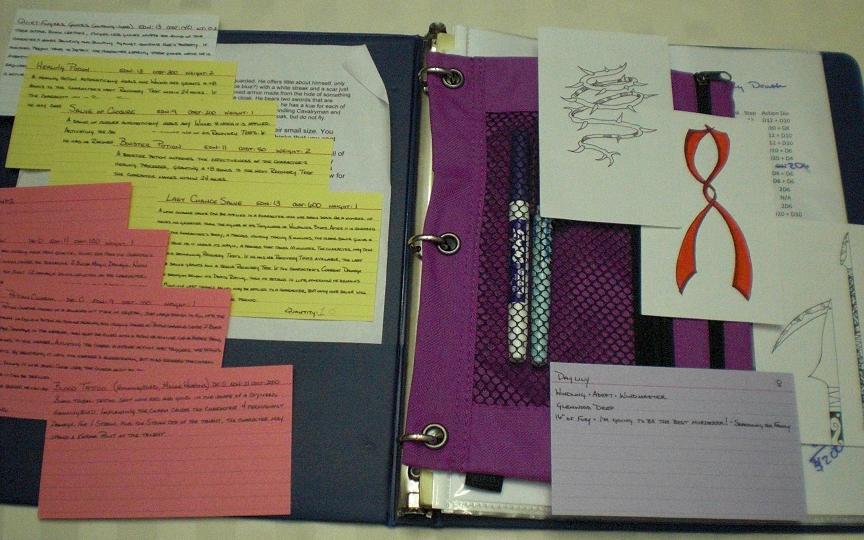
In my previous post on the topic of player aids, I compiled a number of the player aids that I had introduced in my game to help organize the information and minimize the amount of time spent looking in books for relevant text. The primary tool for that is the binder and there have been a few requests to see more of what I include in the binders that I put together for my players. That will be the topic for this post with lots of pictures to provide some inspiration and help for others. The picture on the right has all of the note cards kept in the pouch spread out and you can also see the dry and wet erase pens. If you have any questions, post them in the comments and I will be happy to try and address them.


Here is are two pictures that have more detail of the note cards. I use white cards for equipment, in no small part because it easier to put art on the backside for Thread Items; which I am lucky enough to have a player willing to help out on that. Red cards are related to blood, whether tracking Wounds (whenever a character takes a Wound, they get to record it and the scar it leaves for posterity), or Blood Charms. Consumable items are yellow (and generally healing related) because it was the color left over in the scheme. On the right you can see this character's Thread Items and an NPC (in purple) that was encountered during the previous session.


Here you can see the back of the pouch with the note cards stored and the combat cheat sheet I make for each character. It is very limited in what information it contains to mostly what is relevant during combat. The intent is to focus attention and not have information spread all over the place, making options pretty clear. It also gives spaces to track damage, Karma, and whatever notes are important. Such as what to buy with Legend Points at the end of a session.


I use the expanded character sheet with all the pages - just not everyone gets all of them. They are filled out electronically because I'm something of a penmanship snob and spend enough time reading illegible scrawl in lab notebooks at work. While not the most functional character sheets, there is a lot of information spread out, I like the look of these quite a bit.


Recent additions to the group no longer get the equipment sheet, so this is a legacy. Instead I handle all of that through note cards or actual coins. As I've mentioned, I much prefer having physical objects for these because of the additional dimension they bring to the game.


Here is an example of a new character's equipment list instead of a page. It takes longer to put together and takes up more space, but it also requires less time to get details on what is included. Adding and removing equipment in this cannot be any easier. As I have mentioned, I just like the tactile aspect that this brings to the game.


I haven't actually added the additional sections for the newest Thread Item as it was acquired in the last session. So that's going to happen in the next couple of days.


These are the sheets that have all of the ability information on them, including Half-Magic, Talents, Knacks and skills. This cuts down on a significant amount of time hunting through the books to try and track what exactly a Talent does, or the tables referenced (those are included as well, this character just doesn't have any). Since not everyone has a Player's Guide, this helps in that regard as well - you always have access to the information you need, right at your fingertips, with minimal effort. Since the threshold to read all of your abilities is functionally zero, there is a great deal more familiarity with them, whereas in other games it may be lacking simply because you have to get the book, find what you're looking for (which may be a feat if you're not familiar with the layout already), and not get distracted by the art. These also have all of the House Rules included in the text, so they are more useful in that regard.


Step Tables, Result Levels and Combat Options, oh my! I tried making my own for those and gave up because I found out official ones existed. There are a few reasons I still use the old Result Levels despite mostly updating to 3ER and this handout has more than a little to do with it. The standard deviations is the other part. I also use the 1E Step Table because I simply don't have enough d12s to go around, not since I liquidated my collection after I stopped running The Everlasting. I correctly predicted that how Increasing Your Legend worked was going to be a big source of questions, so I created a sheet to clearly explain all of the costs and how it all worked. There are still a number of questions regarding this, but I'm confident it would be a continual issue without this.


The other piece to Increasing Your Legend.


The last page is a thorough explanation of Karma and how it works. This includes all of my particular House Rules, so it prevents some confusion.

06 December 2012

Earthdawn: Part 19 - Creature Trophies 2 (Rules)

This is the nineteenth part in an ongoing series about Earthdawn. Introduction and Index.

One of the more popular elements I've written about seems to be the creature trophies, also one of the more confusing. It wasn't well explained in the House Rules and some aspects of the rules were in flux at the time. This is going to be an attempt at bringing some mechanical clarity to what is going on with the trophies and what other things I may do to expand that.

Specifically, this is regarding loot that can be gathered from creatures after slaying them (the Legend Point value is equal to the silver piece value). Since I went to all the trouble of making the loot, my players wanted to hang onto them - perhaps because it is also fun to look in to your box back on all of the creatures you have murdered. Every adventurer needs a trophy room! As they weren't going to be getting the money from the loot, I implemented a system in which they could expend more money for additional Legend Points.

From a meta perspective, Legend Points are one of the primary goals that drive players, while money is an ancillary concern at best. The premise of this system gives them more of what they want for what they don't care about as much. That being said, that exchange tends to make them more resource poor overall and drives a need to continually make more money to support their Legend Point habit. More than that, it is fun. Decorating (or "setting") loot personalizes it and gives a little piece of history. There are some more mechanics I am considering for this; more on that later.

The costs associated with setting loot are straight forward: for the value of the loot, the Legend Point award increases by 10%, up to a maximum of the original award. So a piece of loot worth 100 silver pieces and Legend Points would cost 100 silver pieces per 10 additional Legend Points. No more than 1000 silver pieces can be spent for 100 additional Legend Points (200 Legend Points total from the trophy: 100 LP from the loot + 100 LP from the decorations). For anything that will end up as a fraction, I round appropriately (which means 0.5 goes to 1). I like an upper limit on things to keep them from just getting silly, and clearly communicates an end. Any particular kind of look can only be turned into a trophy once. If you have a shadowmant stinger that has been set in the blade of an ornamental dagger, you cannot set another shadowmant stinger, even if the setting would be more impressive. This also keeps things from getting out of hand; there is no revisiting trophies to improve them, no trying to constantly eke a little more out of the system. This keeps the focus on present and future; just so we're clear, that's the kind of behavior I am afraid I would engage in, to address it before it can become a problem. Also, once a trophy has been created, you cannot sell it. It can be lost, or perhaps even traded in a significant fashion, just not used for common gain. That defeats the point of the whole purpose, which is to build your actual Legend, and not much is more disheartening than to discover that your hero has literally sold out. On the whole, I find that trophies can make excellent fodder for Pattern Items, so the concept of selling/trading them is one that should be engaged in with great trepidation. "Why do they want this?" should be an important question.

Now all of that is assuming that you are paying someone to do this for you. As an adept, you have an artisan skill, maybe some crafting skills, or even Half-Magic that could be useful (you lucky Weaponsmith, you). DIY has always been a great way to keep costs down, so why should this be any different? Well, the mechanics all of the sudden need another, much larger, dimension: Difficulty Numbers. The costs are simple: half of whatever it would cost to pay someone to the setting for you. So the above example would cost 500 silver pieces to add +100 Legend Points to the award. Whatever artisan skill is used should be appropriate to the loot itself - death moth wings may not be well suited to a Weaponsmith's Half-Magic, but an earth q'wril beak certainly is.

Difficulty Numbers - I am still working out exactly what they should be, but here is my current list:

Difficulty Number Value
4 1-25
5 26-50
6 51-75
7 76-100
8 101-150
9 151-200
10 201-300
11 301-400
12 401-500
13 501-750
14 751-1000
15 1001-2000
16 2001-3000
17 3001-5000
+1 +5000

Each of those is the Difficulty Number for a +10% increase. Each additional +10% increases the Difficulty by 1. The above example (loot worth 100 silver pieces and Legend Points) would have an initial difficulty of 7, but increasing it to the maximum would cost only 500 silver pieces, but have a difficulty of 16. The biggest question surrounds the Difficulty Numbers themselves and they are a work in progress still. My goal is for making a trophy possible for a skilled character at the lower end (say, +10 - 30%), while the upper end (+70-100%) is a risky proposition. So far that seems reasonable and opens up some area in the beginning for First Circle characters to get in on the fun, while still demanding that high Circle adepts continue to advance their artisan skills to take advantage of trophy decoration. That is part of what I like about this: it encourages characters to continue investing in their artisan skills, which is always fun.

The additional mechanics that I mentioned up-post would be a small once per session bonus related to the trophy, reflecting something demanded or learned in the course of defeating it. Perhaps +1 to Initiative for one round from espagra scales, or ignore 1 point of damage from an attack from a trophy of a fight you died. This concept is still germinating, but I'm putting it out there to see what the thoughts are on it. The bonus doesn't necessarily have to be the same for every character, but it should be related to the trophy and the memory of the event.

Trophy and Game Aid Examples:

20 November 2012

Earthdawn: Part 18 - Play Aids 1

This is the eighteenth part in an ongoing series about Earthdawn. Introduction and Index.

This article is a compilation of five game aids that were introduced in the Adventure Logs, and discussed how they were constructed (if applicable) and what they brought to the game. Covered here are player boxes to hold trophies, coins, dice and sundry; physical coinage; note cards; binders; and a party treasury. If you have been keeping up with the Adventure Logs, there isn't much to see here. If you have given them a pass, there may be something of here of interest.

The first play aid I introduced for my players was binders. They were created for each character and have a combat summary; a chart with the action dice, steps, and result levels; combat option sheets; expanded character sheets; full descriptions of all Talents and skills (including any relevant tables); and pouches to keep note cards. Everything is in sheet protectors and all of the players have dry erase markers, which can be used to make notes on the sheet protectors - track damage, make notes, reminders, gibberish that can only be interpreted as some kind of psychological warfare as I puzzle over it for hours, you know, player stuff. All of this is to try and move things along quickly, particularly combat, by putting all of the relevant information at each player's hand without anyone getting lost in the Player's Guide. The ability to write on the sheets and then easily clean it up means that everything stays legible longer and combat notes are easy. For games that have a lot going on, this is a very helpful system for me. In other games I have included information from between games in the binders as an easy way to disseminate information without exactly letting each player know fully what was going on.

One of my favorite play aids, no matter what the game, is note cards. These are the best way for me to distribute things that I want players to have in some way and tend to quickly go on replacing traditional ways to track various things. For example, I have cards for every piece of equipment with the game effects and stats (including weight and cost), along with a description. This helps save time looking things up (including buying more, or even making it), gives a place to take notes and also tracks who actually possesses the item in question. All of this is doubly true for Thread Items. They make great handouts and a useful way to introduce new characters. Make a card with their Name and some key traits about them; easy descriptors to convey the important elements about them. Players can then take notes about that character in one place. I prefer to color code my note cards, so I know at a glance what I have; for example, purple is people, green places, red blood magic, white equipment, blue key items, and yellow consumables. An interesting way to implement theft is to quietly remove a card from a stack and then have the theft noted when the player notices the item is missing. This is not a good idea for every group or player, though can be effective for groups that appreciate that kind of play.

To really up the ante on personal production values and give them a place to keep all of their stuff, I introduced boxes for each player. Since they were going to be getting more props, it was clear that they would need something in which to keep them. Also, dice rolling was getting a little out of hand at times - I'm not a fan of dice continually rolling off the table and onto the floor. To solve all of these problems, I picked up some pine boxes from a local craft store (Jo Ann's), wood stain in a variety of colors, and adhesive backed felt in a number of colors. The boxes were stained and the bottom of the interior and underside of the lid had felt applied to them. The idea being that the box would be a holding place and the lid would be used for rolling. Unfortunately for me, the lid tended to just become another holding place for Karma dice. The best laid plans.

In a continuing effort to remove actual bookkeeping from my players and give them tactile elements to play with, I introduced Campaign Coins. While the players were hesitant at first (it seemed something like an extra step with counting and all to manipulate the monies), it was quickly shown to be a success. There is something visceral about handling actual money that writing and erasing numbers cannot replicate. It is difficult to write about because it is purely physical. Funds become more real, and players are both more willing to spend them - a cost may be incidental if all you have to do is hand over some coins - and also more aware of them: their piles of coins start to actually vanish. From a GM perspective, it's much easier to track funds: players either physically have them, or they don't. Doling out treasure can be as simple as grabbing a handful of the right color and size; much faster than a die roll and has a more random feel since it will be in different denominations. This is made much easier by having a box to put all of these coins in for each player.

The group treasury was an element which really helped to bring everyone together. The idea certainly isn't a new one, but many players are hesitant at the idea of one player recording all of the group things and effectively having control over this resource in addition to their own resources. This is not an unfair sentiment. To directly address that, while still providing the benefit of pooled resources, I got a physical box to keep everything in. It's similar to the player boxes, but a little smaller, a different shape (hexagon vs. circle), with hinges and a latch - it is clearly a different box. Since money is tracked by actual coins and nearly all of the other consumables have tokens, everything fits in the box nicely and can be clearly interacted with by each player. This means there is no gatekeeper to the funds, that donating to it is as simple as tossing coins inside, and what is available is readily apparent. The actual results are very different as well. Since it's introduction, most of the players donate nearly everything to the group treasury. One player only donates most of it, and he gets some gentle ribbing, which is still remarkable. The physical construct focuses attention in a way that abstractions do not. For any groups looking to promote more cohesion, I cannot recommend these enough.