 After my review of Psi*Run, a reader asked about my thoughts on turning the game into something suitable for campaign-style play. I told them that I would get back to them and here are the efforts towards that end.
Just extending the story with the mechanics in place doesn't appeal to me. One of the things I love about Psi*Run is how tight it is, that it pressure is always on and you are running to the crossroads. I didn't want to tamper with that experience, I wanted to try something different.
Things which make Psi*Run a unique experience (to me) include: the cooperative nature, making hard choices, explicit consequences and the constant visible pressure of the chasers. The elements in a game that keep me engaged in a campaign, even a limited one: a mystery that advances, and character improvement.
With that all in mind, here is my first draft of proposed changes and some discussion on them. The primary changes are to the Risk Sheet and how the Risks play out, as well as some personalized Risks. I would love to hear thoughts on these modifications. If anyone decides to use them, that would be great. Let me know how they turned out for you. Leave a comment!
Goal:
6: Runner achieves goal and finds a clue. Player has first say.
Other results as per book.
Special Addition: If the runner’s goal is resolving a Clue, Goal leaves play for that action and Clue is used instead.
In play I never found any reason to put a high number on Goal, which isn't a bad thing as there are plenty of ways for things to go wrong besides this. I wanted to include a reason to put a good roll there and this also seemed like a great way to also introduce further Clues into the story.
Reveal:
4: Runner finds a clue. GM has first say.
Other results as per book.
4: Runner finds a clue. GM has first say.
Other results as per book.
When given the option to have reveal that answers a question, a player may always elect to select a new question instead (no runner may have more than six unanswered questions at a time). First say is determined as normal. Alternatively, the player may also elect to find a clue regarding whatever is going on (first say is determined as normal). Every question that is answered gives each runner 1 experience point, regardless of whose question was answered.
The range of reveals was reduced to both slow that process down - it would yield too much XP too quickly - and increase the emphasis on the evolving group nature of the game. Ideally the first session or two will be more reveal-centric with sessions after that focusing more around clues and working together to resolve them. Memories would still feature prominently, but they would become something that evolves from the story, rather than directing it as they do initially.
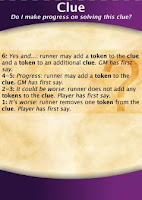 Clue: Do I make progress on solving this clue?
6: Unexpected find: runner may add a token to the clue and a token to an additional clue. GM has first say.
4-5: Progress: runner may add a token to the clue. GM has first say.
2-3: It could be worse: runner does not add any tokens to the clue. Player has first say.
1: It’s worse: runner removes one token from the clue. Player has first say.
4-5: Progress: runner may add a token to the clue. GM has first say.
2-3: It could be worse: runner does not add any tokens to the clue. Player has first say.
1: It’s worse: runner removes one token from the clue. Player has first say.
Clues are additional story points that are added through the actions of the runners. They can be an item, a place, a name, even a memory. A clue should never be in the form of a question, but a statement, nor should it be possessive (it isn't anyone's clue). Questions can, and often should, arise from clues. When a clue is brought into play, write the clue on a notecard and perhaps some details about when, where and how it was found. Resolution of a clue involves a series of actions specifically dedicated to uncovering what the clue means. The successful actions taken to resolve the clue ideally will inform the nature of the clue that is resolve (e.g. resolved from investigating the sewers should be related to something sinister happening, or winding up, down there). When there are a number of tokens on a clue equal to the number of runners, the clue is resolved. Every clue that is resolved gives each runner 1 experience point. The objective of clues is to give structure to what is going on and provide a longer running narrative.
Psi:
 Power E
6: Powers cause no trouble. Player has first say.
5: Power blip: things go mostly, but not entirely, as intended. Other players have first say.
1-4: Power flux: something goes wrong in the immediate area and things are broken or people hurt. After dropping dice as appropriate select one of the following: goal is achieved on 5+, or no more than a 4 may be placed in chase or harm. Harm may be risked if it was not initially risked. Other players have first say.

6: Powers cause no trouble. Player has first say.
5: Power blip: things go mostly, but not entirely, as intended. Other players have first say.
3-4: Power flux: something goes wrong in the immediate area and things are broken or people hurt. After dropping dice as appropriate select one of the following: goal is achieved on 5+, or no more than a 4 may be placed in chase or harm. Harm may be risked if it was not initially risked. Other players have first say.
1-2: Power rush: something goes wrong and engulfs the room. People may be injured, things broken. After dropping dice as appropriate select one of the following: goal is achieved on 6+, or no more than a 4 may be placed in Chase or Harm. Harm may be risked if it was not initially risked.GM has first say.
 Power C
6: Powers cause no trouble. Player has first say.
5: Power blip: things go mostly, but not entirely, as intended. Other players have first say.
3-4: Power rush: something goes wrong and engulfs the room. People may be injured, things broken. After dropping dice as appropriate select one of the following: goal is achieved on 6+, or no more than a 4 may be placed in chase or harm. Harm may be risked if it was not initially risked. Other players have first say.
1-2: Power surge: people may be injured, things broken - it would make local news. After dropping dice as appropriate select one of the following: no more than a 4 may be placed in chase or harm. Harm may be risked if it was not initially risked.GM has first say.
 Power B
6: Powers cause no trouble. Player has first say.
5: Power blip: things go mostly, but not entirely, as intended. Other players have first say.
3-4: Power surge: people may be injured, things broken - it would make local news. After dropping dice as appropriate select one of the following: no more than a 4 may be placed in chase or harm. Harm may be used if it was not initially risked. Other players have first say.
1-2: Power eruption: people are dead, things destroyed - it would make national news. After dropping dice as appropriate select one of the following: no more than a 2 may be placed in chase or harm, or no more than a 4 may be placed in chase and harm (harm must be risked). Harm may be risked if it was not initially risked. GM has first say.
Psi powers are closely tied with advancement and as you grow more powerful, so do the opportunities to cause horrific damage with increasingly dire consequences. At the crash each runner has the following psi limitations: One effect (e.g. movement, destruction, healing, creation, stealth, information, interaction, etc.) and may only affect their self, or a very small effect/range if self is inappropriate. Use Power Risk E.
Harm:
2: Runner is hurt and impaired for the rest of the session. GM has first say.
1: Runner is hurt and impaired for the rest of the game. GM has first say.
2: Runner is hurt and impaired for the rest of the session. GM has first say.
1: Runner is hurt and impaired for the rest of the game. GM has first say.
Other results as per book.
Special Addition: Another player may elect to take the Harm from this result instead of the acting player. The hurt player will have first say for all aspects of this action (except Chase).
Impaired:
Special Addition: Triply impaired: You may not take actions until you have recovered to at least doubly impaired. Another runner’s action must always include moving you when advancing to the next locale. If another runner is not present at your locale, then actions must be spent to arrive at your locale before the chasers do. If chasers are at the locale of a character that is incapable of taking actions, they are automatically caught unless another player spends their action to move the character. Alternatively, Help may be used to resolve this. See “Help” below under other uses for experience.
Given the goal of having long-term play, I wanted character death to really be in the control of the player and have capture be the far more serious long-term consequence. As well being impaired for the rest of the game is a pretty big deal when that game is more than three sessions. That being said, things can still get very rough for everyone if you get very roughed up.
Chase:
Results as per book.
Capture:
Results as per book.
Results as per book.
Capture:
Results as per book.
Disappear:
Results as per book.
Special Addition: If a runner disappears, players immediately receive a clue regarding where the character has disappeared to. Character that has been captured may participate in actions once a scene in a limited fashion until they have been rescued by the other characters (which really should be all that they are doing until resolved). This is can be an excellent opportunity for the captured character to have reveals and gather clues.

At half the cost of an advancement (rounded up), a runner may instead purchase Help. Any runner may only have one unused Help at a time. After a roll, any player may decide that the acting runner receives Help from an outside agency that will be defined at the time. The player that makes this decision will be expending their help. The player may then adjust one die to a 6 to represent this help and the nature of the help provided should be directly related to where the affected die was placed. The die may not be adjusted any further by other advancements the runner may have. Once defined (e.g. cab driver), there can be no other Help from another cab driver, only that cab driver. Each time that helper is used another defining characteristic must be added by the player being helped.
Given the proposed cost of advancements below (equal to the number of players), an astute reader will note that once you have enough experience points to purchase help, it can then quickly be leveraged into providing increasing amounts of experience points to the group as a whole. Since the cost is half the number of players (rounded up) and will provide experience points equal to the number of players, this can be used to provide a lot of reveals early on. As things proceed, it should taper off as the costs will break even at best once all of the initial questions are exhausted. This seems to be a feature to me. It encourages players sharing experience points early on and thinking more as how their actions can benefit everyone instead of just themselves. As well it introduces NPCs to flesh out the setting as well as potentially make them relevant to the plot if they were used for a Reveal.

Example of Help: Jesse is in a pickle and is about to be captured by the chasers. He calls on the Help he previously purchased in the form of a rogue chaser that is secretly on the runners’ side (or so they think). The chaser helps Jesse by giving him an opportunity to flee. Later, Jason is in danger of dying from some psychic surgery gone horribly wrong. He calls on Help and decides that the same chaser from before arrives to provide a first aid kit. Jason decides that not only is he a “rogue chaser”, he is also “widowed”. Something about the chaser indicates that fact. Noting that the help (a 6) has been placed in Goal, the GM decides that the clue will be the widowed rogue chaser saying “27 September” before leaving.
 Advancements
 cost a number of experience points equal to the number of runners. Advancements may be purchased at any time prior to the dice roll for an action. You may only select an advancement once unless stated otherwise. If you want faster or slower advancement, adjust the cost of advancements down or up respectively.
Here are some examples, but this list is by no means exhaustive and any input would be more than welcome:
- Talent: +1 to your goal die for a specified type of action: Movement, healing, destruction, building, stealth, interaction, etc. You may select this advancement more than once, each additional selection must be for a different type of action and the bonuses will not stack.
- Skill: if the die on goal is 7+, you may improve any other die by +2. Must possess talent.
- Investigator: +1 to your clue die. You must have a relevant psi power and be risking psi, or have a relevant talent advancement to use this.
- Revelations: if the die on reveal is 7+, may choose the following result: Runner has a memory and answers one of their questions. Afterwards they may ask a new question. Other players have first say.
- Tough: +1 to the harm die if you will be suffering an injury. This may explicitly work if you are taking an injury for someone else, but will not work if someone else is taking an injury for you.
- Help: you may receive help at a future date. This advancement is removed when used. After this is removed, you may select it again. This advancement costs half the normal amount (rounded up).
- Psi effect: add another effect to your psi power: Movement, healing, destruction, building, information, stealth, interaction, etc. You may select this advancement more than once.
- Psi control: Power blip is eliminated: "5-6: Powers cause no trouble. Player has first say."
- Psi aptitude: +1 to your psi die for a specific type of effect. You must possess the associated psi effect. You may select this advancement more than once.
- Psi gift: if the die on psi is 7+, you may improve any two other dice by +1. You must possess the associated psi aptitude.
- Psi capacity: you may now affect your immediate area, up to a room, with a proportional increase in power. Use Power Risk D.
- Psi potential: you may now affect a large area around you, up to a building, with a proportional increase in power. Use Power Risk C. You must possess psi capacity to select this advancement.
- Psi power: you may now affect a significant area around you, up to a city block, with a proportional increase in power. Use Power Risk B. You must possess psi potential to select this advancement.


