Showing posts with label Namegiver. Show all posts

04 November 2020

Earthdawn 4E: Rules Variant 13 - Revised Namegivers

This is the thirteenth Rules Variant, part of an ongoing series about Earthdawn Fourth Edition. Introduction and Index.

Everything contained here is the work of a fan and not associated with FASA Games.

As may be clear if you're a regular reader, I spend an awful lot of time thinking about Earthdawn and how everything fits together. The system and setting reinforcing each other is a big part of that when considering how to implement something new.

Part of this is also looking back on past work and seeing how to improve it. This isn't always a case of something being bad or broken (which requires erratum), but making it better. Constant improvement because the me of today knows more than the me of seven years ago, just as the me of tomorrow will know more than the me of today.

All of this is to say the Namegivers in the Player's Guide are among the things I've been considering over these years. Again, I don't think they are bad as presented in the 4E Player's Guide, but I think some small tweaks and some larger changes may improve the viability of some character concepts and thus increase diversity.

This is not perfect and represents work in progress for testing, but I think it has some important moves in the right direction. These updates are based on the Hindrance rules variant I introduced previously and account for the greater importance Strength has in determining armor choices. The Movement Rate Modifier listed is based on the Movement Rate variant I posted long ago, updated to reflect the adjusted starting Attribute Values (and as a reminder it exists). The formula is the same (DEX + STR + Modifier), but the modifier may have changed. Abilities are noted and unchanged if there's no text. If they're unlisted, they were removed.

A brief list of changes:
  • Dwarfs: Starting Strength Value.
  • Elves: Starting Toughness Value.
  • Humans: Unchanged.
  • Obsidimen: Increased Wound Threshold and natural armor.
  • T'skrang: Ranks in Swimming.
  • Orks: Unchanged.
  • Trolls: Starting Dexterity and Strength Values.
  • Windlings: Staring Dexterity, Strength, and Willpower Values, Movement Rate Modifier, increased Physical Defense, and weapon sizes.


Dwarfs

Game Information

Starting Attribute Values
DEX 9, STR 11, TOU 12, PER 11, WIL 11, CHA 10
Movement Rate Modifier: -2
Karma Multiplier: 4

Dwarf Abilities
Heat Sight
Strong Back:
This does not affect Hindrance.
Weapon Sizes: Size 1-3 is one-handed and Size 4-6 is two-handed.


Elves

Game Information
Starting Attribute Values
DEX 12, STR 10, TOU 9, PER 11, WIL 11, CHA 11
Movement Rate Modifier: +1
Karma Multiplier: 4

Elf Abilities
Low-Light Vision
Weapon Sizes: Size 1-3 is one-handed and Size 4-6 is two-handed.


Humans

Game Information

Starting Attribute Values
DEX 10, STR 10, TOU 10, PER 10, WIL 10, CHA 10
Movement Rate Modifier: 0
Karma Multiplier: 5

Human Abilities
Versatility
Weapon Sizes: Size 1-3 is one-handed and Size 4-6 is two-handed.


Obsidimen

Game Information
Starting Attribute Values
DEX 8, STR 18, TOU 13, PER 9, WIL 10, CHA 9
Movement Rate Modifier: -3
Karma Multiplier: 3

Obsidiman Abilities
Increased Wound Threshold: Add +2 to the Wound Threshold of obsidimen to represent their inherent resistance to damage because of their stone-like skin.
Natural Armor: Obsidimen have very tough skin, which serves them as armor. Obsidiman skin has a Physical Armor rating of 2. This is cumulative with other armor. However, obsidimen can only wear living or stone armor, or armor-like clothes (such as an espagra cloak).
Weapon Sizes: Size 2-4 is one-handed and Size 5-7 is two-handed.


Orks

Game Information
Starting Attribute Values
DEX 10, STR 13, TOU 11, PER 10, WIL 8, CHA 9
Movement Rate Modifier: 0
Karma Multiplier: 5

Ork Abilities
Gahad
Low-Light Vision
Weapon Sizes: Size 1-3 is one-handed and Size 4-6 is two-handed.


Trolls

Game Information
Starting Attribute Values
DEX 9, STR 15, TOU 12, PER 9, WIL 11, CHA 10
Movement Rate Modifier: +1
Karma Multiplier: 3

Troll Abilities
Heat Sight
Weapon Sizes: Size 2-4 is one-handed and Size 5-7 is two-handed.


T’skrang

Game Information
Starting Attribute Values
DEX 11, STR 10, TOU 11, PER 10, WIL 10, CHA 11
Movement Rate Modifier: 0
Karma Multiplier: 4

T’skrang Abilities
Natural Swimmer: T’skrang are natural swimmers and have limited use of their gills (see p. XX). They also automatically start with Swimming rank 2 as a skill. If the character selects a Discipline with access to Swimming as a talent during character creation, this can be exchanged for a Rank 2 knowledge skill. This does not provide talent ranks under any circumstance.
Tail Combat
Weapon Sizes: Size 1-3 is one-handed and Size 4-6 is two-handed.


Windlings

Game Information
Starting Attribute Values
DEX 12, STR 6, TOU 8, PER 11, WIL 8, CHA 12
Movement Rate Modifier: -5/+5 (Flying Movement Rate Modifier)
Karma Multiplier: 6

Windling Abilities
Astral Sight
Flight
Weapon Sizes: Size 1 is one-handed and Size 2-3 is two-handed.

13 November 2012

Earthdawn: Part 17 - Versatility

This is the seventeenth part in an ongoing series about Earthdawn. Introduction and Index.

Versatility is the racial ability for humans in Earthdawn and it is the most powerful and most complicated racial ability available. In most settings humans represent a relatively simple, baseline character to become familiar with the setting and system. This is not the case in Earthdawn and effective leverage of their Versatility Talent requires a significant degree of system mastery and an unusual level of character planning will also be useful in getting the most out of this unique Talent. The only drawback of Versatility is that heavy dabbling will stunt character advancement.

For those that are not entirely familiar with the system, Versatility allows you to purchase Talents which you may not normally have access to. There are three primary limitations to this: 1) You may have a number of Talents through Versatility up to your Rank in Versatility; 2) You may not acquire a Talent through Versatility which is a Discipline Talent for one of your Disciplines. Though if you acquire an additional Discipline with a Talent that you purchased through Versatility as a Discipline Talent, it will become a Discipline Talent when you achieve the appropriate Circle and free up a Versatility "slot" after the Discipline Talent is raised to the same rating as the Talent gained through Versatility; and 3) All of these Talents must be taught by an adept that knows them (not necessarily as a Discipline Talent) and you must have at least the Circle when your teacher learned it. For example, if the Warrior teaching you Swift Kick learned it at 6th Circle, then you must be at least 6th Circle to learn it and will raise it as a Journeyman Talent, despite that a Warrior can learn it as early as 2nd Circle as a Novice Talent.


What this functionally means is that humans can bypass the traditional structure where every other Namegiver learns Talents: Disciplines. They can cherry pick Talents to suit their character and acquire what may be key Talents without learning additional Disciplines. The human restricted Journeyman Discipline is an apotheosis of this idea: all they have is two Versatility Talents. This Talent is best used in a two different ways: to provide a greater range of abilities (width) or increase effectiveness in a particular field (depth).

By far the most common and intuitive use for Versatility is for additional functionality in a Discipline. This can include a Nethermancer that wants to dabble in being a merchant and the social game, or a Swordmaster that sees themselves as a hard-boiled fantasy detective. This goal is also relatively easy to attain; it involves determining what areas you would like to expand into and what Talents would be most effective for that. It is always worth weighing if it is worth investing the resources for width if it can be accomplished with a skill to the same degree. If you are looking for no more than 4 ranks, then a skill (if available) is going to be a better choice in the long run. The advantages of Talents are long-term and will likely not be fully realized for minor purchase. No matter what your end goal with Versatility is, having a plan is important.

For the aforementioned Nethermancer, that would include Evaluate and Haggle to be a merchant, but the social Talents will require more time. First Impression is always a good place to start, but from there things can get tricky as there are a number of options (Etiquette, Flirting, Impress, Lasting Impression, Seduction, Winning Smile, etc) and may or may not be appropriate for what the goal for that character is; perhaps a skill may be better for some of these Talents. The Swordmaster is in a similar situation as there are a great number of Talents to gather information in different ways, from Astral Sight, to Direction Arrow, to Evidence Analysis and on to Search. As you can see, having a plan is important.


Here is an example: Erich, a human Warrior, has decided that while being a Warrior is sweet, he wants more to do than just murder. He would like to be more involved in social situations and able to gather useful tactical information for the group. For social Talents, he feels that Etiquette and First Impression will maintain his Warrior persona well, conveying a sense of decorum and strength, while allowing him to contribute. His other goal is a little trickier, but in the end he decides that Call of Harrow (for Horrors and Horror Constructs) and Creature Analysis (for most everything else) will be useful. He considers Astral Sight, but is uncertain how often he would actually benefit from the information, but keeps it in mind. Empathic Sense and Thought Link really appeal to him and what he could do with them, but he has quite a bit for now and isn't certain how he will pay for what he wants already.

Improving the depth of an adept through Versatility is a trickier proposition and there are two ways of going about it: Find what will make you better at what you are already good at, or find the weaknesses in what you are good at and fill those out. A simple example of getting better at something you are already good at is for every spellcaster: learn the Thread Weaving Talents of the other spellcasters. With Nethermancy, Spirit Hold, Spirit Talk and Summon [Ally Spirits], a human Elementalist could easily fake it as a Nethermancer. Now, there are some caveats to this: despite being explicitly allowed, not all GMs might be a big fan of this plan, and with good reason - it represents an amazing expansion of what you can already do, both width and depth. Within setting, most spellcasters will be hesitant to give up their secrets so easily. To minimize your weaknesses, look at what your Discipline does well, then figure out what it does poorly in that realm. Sky Raiders, despite the use of Fireblood, don't actually have much in the way of defensive Talents. A human Sky Raider might think about Life Check and Temper Self, or even Air Dance for both initiative and potentially another attack (both things they aren't so great at).

Here is an example: Elena, a human Swordmaster, has decided that being a Swordmaster is sweet, but she wants to kick even more ass (also be less in danger of falling unconscious constantly). She has a few problems to tackle, but damage, initiative and toughness are the biggest ones. She decides that Cobra Strike will be her best bet on initiative - she is having a hell of a time against Parry and most of her Swordmaster opponents already have a good initiative, so getting an Excellent result will be difficult, but just beating them shouldn't be that hard. Damage is trickier, but Down Strike and Great Leap will be dependable solutions. She has also seen her sister use Swing Attack and wants in on that - it increases damage and is awesome. For taking additional damage, Wood Skin is attractive, but forethought isn't really her wheelhouse, so she goes with Fireblood.

Hopefully this discussion on Versatility will useful in showing how it can be used (perhaps abused) in any game and new ways to think about what can be accomplished with it. As usual, any questions or additional information is always welcome in the comments.

08 September 2012

Earthdawn: Part 5 - Thread Magic

This is the fifth part in an ongoing series about Earthdawn. Introduction and Index.

As has been stated before, magic is everywhere in Earthdawn. It is the heart of the setting and the system. If you ever talk to a fan of Earthdawn, it will not take long for the conversation to quickly turn to the magic. The threads of magic weave together to create a complex pattern, which is unique to Earthdawn. Magic touches the life of every Namegiver in Earthdawn, whether they are an adept exploring the strange and often broken world, or a villager still utilizing the fertility of the kaer as they try to build a new life.

There are two forms of magic in Earthdawn, common magic and Thread magic. Common magic can often be created through alchemy which is a skill that anyone can use. It is practical science in a world of high magic. Thread magic is where you begin to manipulate the fabric of reality. At the risk of sounding cliche, it is where the real magic resides.

Previous articles have been incorporating some of the various concepts that are important for magic in Earthdawn. They have danced around the topic and informed some of the primary ways that characters interact with it. Hopefully it has given some reference for the metaphysics underpinning the setting and system. Now we're going to get at the meat of the subject: Thread magic.

The basis of all Thread magic begins with a Pattern. Each Pattern is unique and has a Name. Interacting with a Pattern on a fundamental level involves Weaving Threads to it. Only adepts can perform this feat, using the Thread Weaving Talent. Each Discipline has their own variation of that Talent (e.g. War Weaving for Warriors, Threadsmithing for Weaponsmiths and Wizardry for Wizards), but they are largely the same, though there are some differences which will be addressed later.

Every Namegiver has a Pattern and as discussed previously, it is through their actions that other things gain Names and Patterns. Places of significance can earn a Name, and thus a Pattern. The province of Barsaive received its Name from the Therans when they claimed it as a part of their empire. Prior to that it was a collection of tribes and cities, though nothing of importance. It was through that Name and Pattern that Barsaive became a thing. The province gained a cohesion that had never been known before. Barsaive itself became a living thing with rudimentary desires, and the Namegivers living there felt the new bond of identity. That is the power of a Name. Items can also gain Patterns and Names, whether they are intentionally created with a Pattern, or they earn them through legendary deeds.

The Patterns of people and places will generate Pattern Items over time as their legend grows. These items are important somehow to the legend of that Namegiver or place. They do not have a Pattern of their own, but are an extension of the greater Pattern they represent. As the legend of the original Pattern grows, new Pattern Items may be formed and/or old Pattern Items may grow in importance. It is through these items that you can Weave Threads to the core Pattern. If you have access to a Pattern Item of significant enough importance, you can affect major changes to the basic nature of the Pattern and Rename it. Blood Wood is the most famous example of this action, becoming a macabre reflection of what was once beautiful by misguided hubris.

By Weaving these Threads you can gain power while acting in that location, against that person (including Named Horrors), or give strength to the person through your Thread. For these reasons the Pattern Items for places of importance are highly sought after and protected, and there is great danger in having your Pattern Items stolen. Entrusting a comrade with a Pattern Item is a display of significant trust, often accompanied by a Blood Oath. Through such a partnership both parties can benefit significantly.

One option that adepts have available to them is creating a Group Pattern. It is a special type of Pattern that requires all involved to swear a Blood Peace with each other - they may take no action against those they share this bond with. The Group will need a Name and a sigil, and each member will need to select an item of importance to them in relation to their role within the Group. These will often be related to the events that brought the Group together, or their early exploits. The items will become Pattern Items for the Group and for each adept. Through this Group Pattern, the adepts may strengthen their abilities when acting as a part of, or in the direct interests of, the Group by Weaving Threads to their Group Pattern Item. This provides a framework to show the importance of cohesion and that the adepts are not a collection of individuals, but a part of something greater than the sum of its parts. There is a definite change once the Group Pattern is formed, though it is not uncommon for some players to initially abstain. In general, it doesn't take long for them to take the oath as the benefits can be significant.

Though Pattern Items and Thread Items are similar, they are different in how they function. Pattern Items are only an extension of a larger Pattern and through that connection they grant access to the greater Pattern. Thread Items have their own Pattern and are special on their own, even the most generic Thread Item metaphysically has a unique identity and a Name. Thread Items are the equivalent in Earthdawn to magic items in other settings, though so much cooler. They have a legend, not necessarily an extensive one, but that just leaves more room for the item to grow with you. As above, your items can spontaneously generate a Pattern through involvement with your legend, taking abilities associated with your exploits. Items that already have a Pattern can generate new Ranks based on your Legend. This is why magic items in Earthdawn are often spoken of so highly: they have personality, and they are yours in a way that a +1 flametongue never will be.

Before you can Weave a Thread to a Pattern, you first must know about the Pattern. In the case of your own Pattern, this is rarely going to be an issue. For your Discipline, you are learning about it by walking its path and meditating on what it means. In-game this is represented by raising Talents, performing your Karma Ritual, and ultimately training for a new Circle when you have mastered your current curriculum. For Pattern and Thread Items, this means learning Key Knowledges.

Key Knowledges are pieces of information about the Pattern that are integral to the legend that formed it. The first Key Knowledge is always the Name of the Pattern. For weaker Patterns, that may be the only Key Knowledge, but by the same token the Threads that can be Woven will be weak as well. The more legendary the Name, the more powerful the Pattern and the more Key Knowledges that must be learned to Weave ever stronger Threads to the Pattern. This is particularly true of Thread Items and will represent a significant portion of many adepts' activities: tracking down Key Knowledges. The catch to a Key Knowledge is that it must be learned through some action. Simply reading it in the Great Library might work for a Name, but after that point you have to get your hands dirty and begin to walk the path of the legend. Sometimes even engaging in Deeds that relate to the legend: performing actions that the item was originally used in to build its legend.

This mechanic for Thread Items creates instant adventure. It gives every player a stake in the world and an active interest in engaging in it. Thread Items can be used to tell entire stories unto themselves, reveal secrets, set adepts onto righting ancient wrongs, or any number of campaign developments. At the very least, Thread Items add considerable color to the world and represent a chance for each character to leave their mark on the setting. The downside to this is that Thread Items represent a considerable amount of work. Handcrafting them is an investment, both in the mechanics and the setting material. Despite that, I have always found it to be worth the trouble. There is something about finding a Thread Item in Earthdawn that is hard to define. Since improving Threads to the item is limited by Key Knowledges (and Legend Point costs), it is not a big deal to hand out powerful items early on. The advancement of the item is easily controlled, but there is a certain joy in having your things grow with you. The entire experience has powerful mojo. I can guarantee that any Earthdawn player will be more than happy to tell you all about their Thread Items.

To help with the extensive work surrounding Thread Items, I will be writing a series of articles regarding how I go about creating a Thread Item. As well, there will be additional posts on specific types of magic, such as blood magic, spellcasting and crafting items.

04 September 2012

Earthdawn: Part 3 - Namegivers and Names

This is the third part in an ongoing series about Earthdawn. Introduction and Index.

The sapient races within Earthdawn are known as Namegivers, though not all Namegivers are appropriate for PCs (dragons come to mind). They feature fantasy staples (dwarf, elf) as well as original entries (obsidimen, t'skrang), but all are at least somewhat unique in execution. Examples of this are the dwarf love of debate and bright color, and the contrast of orks as both raiders and the staunch defenders of personal freedom.

Each race has special abilities and attribute modifiers, though these are not directly balanced against each other. The disparity is addressed through Karma. Namegivers with less to offer mechanically have greater access to Karma and the benefits that it provides. Karma allows for temporary bonuses to magical abilities and makes a significant difference. I have never seen a character feel that they were at a disadvantage because of their racial selection.

Here is a list of the playable Namegivers in Earthdawn and things that I like, find notable, or find myself writing about them:

Dwarf: I have never particularly considered myself a dwarf person; maybe it's the stereotypical borderline alcoholism and prevalence of Scottish accepts. That being said, I like the dwarfs in Earthdawn. They are progressive intellectuals and builders. The desire to build manifests in both physical and the abstract; amazing architecture and seeking an ideal civilization. They are the cultural center of the default setting, Barsaive, as well as the most populous race. They have a decidedly ancient Greek feel, as well as a love for bright colors and company. The only issue I have is with the default attributes - high toughness and strength, with a penalty to charisma. This does not really match with the fluff as presented; they are merchants and politicians, not doughty soldiers. A secondary problem is that there are three other Namegivers that have very similar attribute spreads, but all of the get more strength (which is generally sexier than toughness) than dwarfs. This creates a situation where I have rarely seen a PC dwarf despite being about a third of the population. To fix this, I have a house-ruled set of attributes that I feel matches more with the dwarfs of the setting and presents something far less stereotypical.

Elf: Once the center of the culture was within the borders of Barsaive, but since the events of the Scourge things have changed. There is a profound sadness to those elves outside of the traditional seat of power, knowing what they have lost. This is matched by a sense of distrust from other Namegivers; not much is known about the Blood Wood and the Blood Elves that call it home and no one is making an effort to fix that. Beyond this, the elves are still a people of grace and love for all that is beautiful in life.


Human: The major difference for humans and most fantasy settings is that they are only the third most populous race within Barsaive. That is a basic assumption that can be difficult to internalize at times and make come to life at the table, but it can also have a profound affect on how things play out - it makes things feel different and highlights that fact. Humans still maintain their classic trope of diversity. How this is portrayed mechanically is interesting. Typically humans are a go to choice for players that do not want to get too mixed up in mechanics, but in Earthdawn they are by far the most mechanically involved choice. Their racial ability, Versatility, is complex in application, but powerful, particularly when it comes to rounding out a Group. It just requires quite a bit of system mastery to get the most out of it, or even use it.

Obsidiman: Without a doubt the most unique race in a game known for unique races. Despite their name, obsidimen are genderless and formed rather than born. It's complicated, strange and not well explained - obsidimen have little interest in explaining something that no one else can really begin to conceptualize. This is just the tip of the iceberg on why I consider them a roleplaying challenge, to put it lightly. What makes them so interesting is also their greatest weakness: they are so alien, so different, that it is hard to come to terms with what their motivations are. The Liferock is the beginning and end of their existence. It is where they emerge from and return to, melding their memories with those of their brothers. They exist outside of the Liferock for 800 to 900 years, after which they return and don't leave anymore, becoming a more-or-less permanent part of the gestalt consciousness. They truly exist in a different way than the rest of the Namegivers and that can make them hard to integrate. However, they can also be very compelling, often stoic characters when they work.

Ork: Another interesting take on a classic fantasy race, also one that shows some of the connections to Shadowrun. Orks occupy some interesting creative space. They are often portrayed as villains - ork raiders, especially the dreaded cavalry Scorchers, are a plague across the land to the people trying to rebuild. In addition, they represent a significant underclass; once a slave race that won freedom and created a kingdom. However it was lost prior to the Scourge in a pointless war. Though the victory over them was Pyrrhic as the opposing kingdom fell during the Scourge. There are also those that are dedicated to ending slavery in all forms and bringing justice, as well as those that seek to reclaim and rebuild their lost glory and pride. As the second most plentiful race, and would likely be the first if they didn't die from violence so often, their stories are likely involve prejudice and working against a system that doesn't seem to want them. Indeed, the entire storyline of Cara Fahd (the ancient ork kingdom) can be particularly moving and tragic.

T'skrang: Easily the most popular race from Earthdawn, the t'skrang are flamboyant matriarchal lizard people that have a nearly unmatched exuberance for life. Flashy in dress and behavior, I have never had a group that did not include a t'skrang and it is not hard to see why - they are just fun. Most of their society exists along the major rivers where they control the trade in family merchant houses. The various houses exist in fierce competition with each other and it is not uncommon for conflict to breakout between rival crews on the riverboats.

Troll: There are two groups of trolls within Barsaive, the highland and the lowland. The lowland trolls are those that have integrated into society at large, though still maintain many of the same traditions. Highland trolls are who most of the stories are told. Living high in the peaks, they raid across the land in their airships and with crystal weapons; high fantasy vikings. No matter where they call home, trolls are all honorable and proud and it is wise to not forget that fact. At around nine feet tall, that is a lot of troll to have angry at you. Trolls are another very popular Namegiver for reasons that should be obvious and I can count the number of games I have run that did not include a troll on one finger.


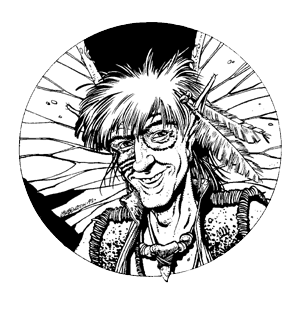
Windling: An example of how many of the default assumptions which most fantasy world exist on are not quite the same for Earthdawn. Windlings are 18 inches and can fly, which presents some unique capabilities for any group to have access. It is easily to equate them to halflings or kender, though not entirely accurate. They are curious about everything and come from very tight-knit communities that share everything; life is rough when you're under two feet tall. This means that they are also absolutely fierce protectors of those they would consider family (including most friends) and rarely think only of themselves. They have some rather unique connections to the world, not the least of which is a natural ability to perceive astral space. Something to be aware of are windling spellcasters. All of the disadvantages windlings have are based around size and strength, receiving compensation in defenses and amazing access to Karma. For a spellcaster, these disadvantages are not disadvantages at all, and the ability to fly means that most dangers are trivial to avoid. I have found that it can be a potentially disruptive character. On the other hand, there is a windling-only melee Discipline, the Windmaster, that capitalizes on the strengths of windlings to make a truly dangerous tiny fighter.

Onto a related topic that highlights another part of Earthdawn that I enjoy. Names are an intrinsic piece of the magic that pervades the setting and system. One of the more subtle, but powerful aspects of Earthdawn. The importance placed on Names can be seen throughout the game and you will interact with them, but as you grow in power their place and importance will become more prominent in ways that I don't necessarily want to spoil right away.

Within the world of Earthdawn, only Namegivers can grant Names through their actions. This is one of the things, perhaps the most significant thing, that makes Namegivers special; Names are powerful. Everything with a True Pattern has a Name, and vice versa. Once something has a Name it becomes alive in a way, it has transcended simply being a place or an object and gained the ability to affect its own fate. This will not necessarily manifest in any particular fashion, but the more powerful the Name, the more events will bend around it.

It is important to note that despite how powerful Horrors are, they are not Namegivers. They can receive Names through interactions with Namegivers, which is a terrifying thing. A Named Horror has a malevolence that transcends and they begin to define their existence through their deeds. There is a danger in Naming things, however once a Horror has a Name, it also becomes an individual with eccentricities and weaknesses. Through preparation, a Group can take advantage of this and they will certainly need all of the help they can get.

Changing a Name will inherently change the Pattern and it will never be the same. A Namegiver that does this will lose all of the Threads Woven to their Pattern, and will begin to lose all connection to their old life. Objects and places undergo a similar process, though require access to a major part of the Pattern, and this decision should never be undertaken lightly. Certainly the elves know that well, and what was once Wyrm Wood stands as a continual cautionary tale of hubris for all.