This is the fifteenth Example Character in an ongoing series about Earthdawn. Introduction and Index.
The obsidiman Warrior is one of the iconic characters in Earthdawn. Enormously powerful, but with a quiet fortitude puts them in contrast with the other combat disciplines. This adept would never be considered a "people person".
Each Circle saw this character improve one attribute and take a new Talent Option. There are no Thread Items on this character, however unlikely it may be.
Note: The entries in this series may be updated periodically as I master the coding to fit all eight of the Circles in a fashion which doesn't result in eye melting. Consider these living entries. Please leave comments if there is anyway this could be made more useful.
Discipline: Warrior
Race: Obsidiman
Attributes:
DEX: 16 (7) STR: 25 (10) TOU: 20 (8)
PER: 13 (6) WIL: 10 (5) CHA: 8 (4)
Characteristics:
Initiative: 7
Physical Defense: 12
Mystic Defense: 9
Social Defense: 5
Physical Armor: 12 (Recommended: Fernweave, Forged +7 [9])
Mystic Armor: 6 (Recommended: Fernweave, Forged +1 [4])
Damage: 27 (Recommended: Freakishly Large Hammer Thing, Forged +8 [17]), 36 (with Crushing Blow)
Unconsciousness: 96 (105, Temper Flesh)
Death: 112 (121, Temper Flesh)
Wound Threshold: 15 (24, Temper Flesh)
Recovery Tests: 5
Knockdown: 18
Karma: 24
Karma: Recovery Test, Damage tests.
Talents:
Avoid Blow: 9 (16)
Melee Weapons: 9 (16)
Tiger Spring: 8
War Weaving: 8 (14)
Wood Skin: 9 (17)
Fireblood: 8 (16)
Wound Balance: 8 (18)
Anticipate Blow: 8 (14)
Air Dance: 8 (15)
Maneuver: 8 (15)
Waterfall Slam: 8
Danger Sense: 6 (12)
Earth Skin: 8 (16)
Lion Heart: 8 (13)
Temper Flesh: 9 (14)
Swift Kick: 8 (15)
Crushing Blow: 9 (19)
Life Check: 8 (16)
Second Attack: 9 (16)
Momentum Attack: 8 (15)
This adept is essentially raw power which has been unleashed. They are an offensive powerhouse; their damage is impressive, Initiative effectively at Step 23 using Air Dance and Tiger Spring, health ratings and Wound Thresholds put up some very impressive numbers, and this is before Wood Skin is added, which will give around another 17 without Karma (putting Unconsciousness and Death up to 122 and 138 respectively), multiple attacks, and numerous ways to stay in the fight for far longer than any opponent wants to come to terms with.
On the surface, they are pretty simple: point in the direction things need to be broken and wait as everything is slowly broken. However, there are a couple of tricks this adept employs. The first is Swift Kick; this talent is used exclusively for attacking to Knockdown. Even with a massive strength, there isn't much to be gained from damage against a reasonably armored opponent. However, when coupled with Waterfall Slam, opponents tend to fall over. Which sets up attacks against a downed opponent, which are more likely to trigger a Momentum Attack.
Mystic attacks are something of a weakness, though Earth Skin and Lion Heart both provide some breathing room. Not a lot, but some. Their most significant weaknesses are social attacks and mobility. Despite their impressive reflexes, they cannot dominate the field with movement. They may barely participate.
Outside of combat this adept has virtually nothing to offer. They are simply a staid guardian, waiting for their next battle.
This is the twelfth Example Character in an ongoing series about Earthdawn. Introduction and Index.
While not iconic, this is certainly popular combination. The idea of a enormous, solemn rock man working tirelessly in a forge, only to come out when needed and lay the smack down is certainly an appealing one.
Each Circle saw this character improve one attribute and take a new Talent Option. There are no Thread Items on this character, however unlikely it may be.
Note: The entries in this series may be updated periodically as I master the coding to fit all eight of the Circles in a fashion which doesn't result in eye melting. Consider these living entries. Please leave comments if there is anyway this could be made more useful.
Discipline: Weaponsmith
Race: Obsidiman
Attributes:
DEX: 13 (6) STR: 22 (9) TOU: 19 (8)
PER: 16 (7) WIL: 16 (7) CHA: 7 (4)
Characteristics:
Initiative: 1 (Recommended: Crystal Plate [-5])
Physical Defense: 10 (Recommended: Crystal Buckler [+1])
Mystic Defense: 13 (Recommended: Crystal Buckler [+1])
Social Defense: 5
Physical Armor: 16 (Recommended: Crystal Plate, Forged +6 [13])
Mystic Armor: 13 (Recommended: Crystal Plate, Forged +3 [10])
Damage: 24 (Recommended: Troll Sword, Forged +9 [15])
Unconsciousness: 78 (87, Temper Flesh)
Death: 94 (103, Temper Flesh)
Wound Threshold: 14 (23, Temper Flesh)
Recovery Tests: 5
Knockdown: 17
Karma: 24
Karma: Craft/repair items, Recovery Tests, Damage tests with weapons adept crafted.
Talents:
Forge Weapon: 9 (16)
Item History: 8 (15)
Melee Weapons: 9 (15)
Steel Thought: 9 (16)
Thread Smithing: 8 (15)
Craftsman: 8 (15)
Shield Bash: 8 (17)
Conversation: 8 (12)
Fireblood: 8 (16)
Suppress Curse: 8 (15)
Avoid Blow: 8 (14)
Wound Balance: 8 (17)
Awareness: 6 (13)
Forge Armor: 9 (16)
Earth Skin: 8 (15)
Temper Flesh: 9 (16)
Fire Heal: 8 (15)
Spot Armor Flaw: 8 (15)
Resist Taunt: 8 (15)
Lion Heart: 9 (16)
Battle Shout: 8 (12)
In contrast to the dwarf Weaponsmith, this is not a well-rounded character. To call this adept gruff would be putting it nicely. I imagine they are interested in doing their duty and doing it very well, but do not have the time for those of a flightly nature. Which would be most everyone. This adept is likely to be the soul of a group as well, but a group which probably spends most of its time hunting Horrors in the darkest places and returning alive time and time again.
This obsidiman Weaponsmith is no nonsense and incredibly dangerous in combat. While still not a full combat discipline, they come very close. Weaponsmiths are still primarily defensive, but the sheer power of an obsidiman supplemented with Spot Armor Flaw, Shield Bash, and Battle Shout allows them more offensive power. This is the kind of adept which haunts the nightmares of spellcasters and Horrors alike. Their arsenal of active defenses (they have collected them all) means there is little which they do not have a chance to shrug off.
Beyond their speed, which is remarkably slow, this adept is very susceptible to social attacks. Once they get access to Resist Taunt, this problem will become less significant (as it uses Willpower, rather than Charisma, an attribute of which they have plenty).
This is the thirteenth Anatomy of a Discipline in an ongoing series about Earthdawn. Introduction and Index.
Overview
Purifiers are an obsidiman-only Discipline that exists somewhat in contrast to the stereotypical view of those Namegivers. Whereas most see obsidimen as clam and slow to anger, a Purifier tends to be significantly more tempestuous, less a craggy mountain and more an avalanche.
Their purpose is to heal the earth. While that is primarily focused on the damage caused by the Scourge and Horrors, that is by no means the limit of their cause. Any that cause wanton destruction or harm will likely earn the unwelcome attention of a Purifier. This harm can take the form of encroaching on unspoiled areas, over grazing or hunting, anything that can have a permanent impact on the balance of the world.
It is important to remember the view obsidimen have of the world and how it has changed. They do not see just the next season, month or even decade; they look to the next centuries and Purifiers in particular how to safeguard that for those that must live there beyond the sunset of the Namegivers that currently surround them. The Purifier gives form to the silent rage most obsidimen feel, but cannot give shape to. These adepts are the passion of their people, and the passion of a mountain is a volcano.
Despite their love and protection for the earth, they understand for somethings to flourish, others must die. Therein lies the balance. For other Namegivers to live, some places must be given over to their needs. It is in the overuse of these sacrifices, refusing to honor what has been lost for them to continue, and the continual need to consume that Purifiers draw the line. Some see violence as their first answer, others see education as the more successful route. Only through teaching can the younger Namegivers be expected to learn. Though a refusal to actually learn and continuing in their decadent ways is a dangerous path to tread as obsidimen have long memories and do not forgive easily; Purifiers see themselves as the earth's vengeance given form and purpose.

While their relationship with other Namegivers may be a source of contention, their main focus is to combat the Scourge. They have the abilities and drive to heal the land in a way that no other Discipline can. Their focus on eliminating Horrors is almost as single-minded as the Horror Stalker.
When playing a Purifier it is important to determine what your philosophy when dealing with Namegivers that may not know better in how they treat the earth. At what point has a line been crossed? A Purifier's demeanor is significantly different from most obsidimen, and that can be an important element to consider - they will likely be a different roleplaying experience and perhaps a study in contrasts.
Discipline Violations
These are best employed not as a stick, but as a chance for the player to take a deeper look at what it means to follow their Discipline. The main concern for any Purifier is their relationship with the earth and how they tend to it. One of the main manifestations of this is likely to be the usage of the Earth Bond Talent to heal the Purifier, which draws life from the earth itself. Too much reliance on this while giving little to nothing back in return could be a significant issue. What may be a point of contention between this adept and their Group is how they deal with Namegivers that may be overstepping their relationship with the land. This could cause considerable for any Group and lead to what others may consider unnecessary violence, or may not understand entirely. While ignoring this duty may be impossible for the Purifier.
Healing the effects of the Scourge is never far from a Purifier's thoughts and their desire to stop and spend time on the land can also be a source of friction. An obsidiman's sense of urgency is typically different from an ork, and with good reason - there is an order of magnitude between their lifespans. Though everyone should find common ground when dealing with Horrors, the Purifier may pursue these goals with a particular fervor.
Talents
Initiate
Talent Options: Acrobatic Strike, Avoid Blow, Battle Shout, Sprint, Wilderness Survival
First Circle
Discipline Talents: Body Control, Clay Skin, Karma Ritual, Unarmed Combat, Wound Balance
Novice
Talent Options: Creature Analysis, Heartening Laugh, Maneuver, Swift Kick, Throwing Weapons, Tiger Spring, Tracking
Second Circle
Discipline Talents: Durability (7/6), Lifesight
Third Circle
Discipline Talent: Spirit Talk
Fourth Circle
Discipline Talent: Thread Weaving [Earth Weaving]
Journeyman
Talent Options: Astral Sight, Earth Skin, Great Leap, Lion Heart, Resist Taunt, Steel Thought, Steely Stare, Temper Self
Fifth Circle
Discipline Talent: Earth Bond
Sixth Circle
Discipline Talent: Life Check
Seventh Circle
Discipline Talent: Crushing Blow
Eighth Circle
Discipline Talent: Momentum Attack
In combat the Purifier is a intimidating, and are the premier unarmed combatants until Disciplines from Cathay are considered. Between Body Control and Crushing Blow as Discipline Talents, and the natural obsidiman strength, they have no issues with damage; this is normally an area of concern for unarmed characters. Momentum Attack can even give them an additional attack, which is one of their downsides.
They also bring some considerable defense to the table with a good Durability, Clay Skin (Wood Skin with a different name), and Life Check. Earth Bond can be used for healing, or fulfilling the function of their Discipline, which is some nice versatility, and Wound Balance as a Discipline Talent coupled with being an obsidiman (amazing strength, great toughness and additional Wound Threshold) means they will never fall down barring some extreme circumstances.
Without taking Talent Options into account, the biggest weaknesses for the Purifier in combat are low static defenses (obsidimen have reduced dexterity, perception and charisma) and not that many options. Besides beating things to a pulp, but there may be a desire for more than that. Lifesight and Spirit Talk give them some unique abilities to a combat Discipline, along with Earth Bond, that strongly reinforce their themes and give them ways to contribute outside of a fight.
Through their Talent Options, a Purifier can build in a number of ways, all of which are probably going to be very effective.
Talent Options for the Purifier is almost a litany of potentially difficulty decisions. Each tier has some great choices depending on what kind of character you want to make and Initiate is no different in this regard:
- Acrobatic Strike - The overall best option the Purifier has for more Physical Defense, but it has some strings attached: initiative and you must attack to use it. It will need continual improvement.
- Avoid Blow - In general, I don't like Avoid Blow as a Talent Option and this is no exception. Purifiers already have a good Physical Defense, which means that without Karma, it will be a difficult task to successfully use this Talent. It will need continual improvement.
- Battle Shout - Though their charisma tends to be rather low, this is still a good debuff and worth of consideration.
- Sprint - Though the concept of a sprinting Purifier is awesome (the fantasy linebacker), obsidimen just don't have the Karma supply to make this worth it and have a lot of great Discipline Talents to spend Karma on already.
- Wilderness Survival - It is already covered by Half-Magic, though as a skill, and there is probably something else in this list. If not, make certain that you are willing to invest in it to actually have it be better than Half-Magic.
This is one of the few Disciplines where you are almost certain to use up all of you Talent Options. Along those lines, introducing some more very good choices at Novice:
- Creature Analysis - Generally more important for spellcasters that can get the most mileage from this Talent, information is always power and this is thematically appropriate for a Purifier.
- Heartening Laugh - It requires Karma (of which obsidimen have comparatively little) and there will probably be a Swordmaster that has this as a Discipline Talent.
- Maneuver - On the whole, there just isn't the need for this as with other Disciplines, though it can give a damage bonus for the patient player that is having issues with high armor.
- Swift Kick - The only downside to this is that you need a better initiative and that isn't really an obsidiman's strong suit. Other than that, this is extremely good.
- Throwing Weapons - The Purifier already doesn't carry any weapons (very successfully) and this seems to defeat the purpose. Along with needing continual improvement and potential investment in Thread Items to keep it competitive at higher Circles, this seems more like a Legend Point sink that something useful.
- Tiger Spring - If you have Acrobatic Strike and Swift Kick, you are going to want this (and if you don't have them, why not?). Otherwise, there isn't any particular need.
- Tracking - This is a great Talent for an adept in every Group to have. If no one else does, you might want to consider this.
Even more things to like at Journeyman! These are the Talent Options that just keep giving:
- Astral Sight - Not many combat Disciplines get access to this Talent and it is one that lets you participate in an entirely different game. With the other Talent Options, this one isn't automatic, but with the theme of the Purifier it should definitely be a strong contender.
- Earth Skin - It may cost Karma, but you are going to want this. Every character should want this and it shows up right when it starts becoming more and more important.
- Great Leap - A lot of fun with an obsidiman, but the typical combo with Down Strike is unnecessary.
- Lion Heart - This Talent is almost always good; it has low investment requirements and is bound to be useful.
- Resist Taunt - A Talent Option I will pass on because of the same reasons as with Avoid Blow. This can simply be too difficult to use when you really need it.
- Steel Thought - Same as Avoid Blow, and with access to Earth Skin there isn't much reason to give it a second glance. It does have one interesting feature compared to all of the other "dodge" Talents: it uses a different attribute than the Defense is derived from, which can actually work out for an obsidiman.
- Steely Stare - Another fun talent for combat characters as it can give you an opportunity to bypass combat or participate in scenes where you may not have as much to do.
- Temper Self - Because the Purifier needed to be able to take more damage. Well... they do, just because. The only real downside to this is the increased damage an obsidiman takes from failure with this Talent (due to their Increased Wound Threshold). This is still an excellent Talent.
Equipment
No matter what direction you are going, armor is always going to be a tricky subject due to the obsidiman living or stone armor requirements. If you need a good initiative (Acrobatic Strike and Swift Kick), then that will limit options even further. For the former group, the best early armor options are stone, but they will generally tank your initiative (stone disk only has a penalty of 3). Later on crystal plate becomes an excellent option. Those that need to maintain a good initiative have more limited options. Fernweave is going to be it unless there are compromises or Thread Items in the mix. The other two armors on the table are blood pebble and crystal ringlet. Purifiers may have issues with blood pebble due to the blood magic and the associated damage. Crystal ringlet will need Smooth Armor and/or initiative penalty reductions from Thread Magic. Of course, everyone needs an espagra scale cloak, unless your GM rules that it falls under the "no living armor" clause for obsidimen.
While it may look strange, there is mechanically little reason for a Purifier to not have a shield. Purifiers without a care for initiative penalties (so long as they remain below their dexterity Step) will likely find considerable use from a crystal raider shield and others from crystal bucklers.
 This is the third part in an ongoing series about Earthdawn. Introduction and Index.
The sapient races within Earthdawn are known as Namegivers, though not all Namegivers are appropriate for PCs (dragons come to mind). They feature fantasy staples (dwarf, elf) as well as original entries (obsidimen, t'skrang), but all are at least somewhat unique in execution. Examples of this are the dwarf love of debate and bright color, and the contrast of orks as both raiders and the staunch defenders of personal freedom.
Each race has special abilities and attribute modifiers, though these are not directly balanced against each other. The disparity is addressed through Karma. Namegivers with less to offer mechanically have greater access to Karma and the benefits that it provides. Karma allows for temporary bonuses to magical abilities and makes a significant difference. I have never seen a character feel that they were at a disadvantage because of their racial selection.
Here is a list of the playable Namegivers in Earthdawn and things that I like, find notable, or find myself writing about them:
This is the third part in an ongoing series about Earthdawn. Introduction and Index.
The sapient races within Earthdawn are known as Namegivers, though not all Namegivers are appropriate for PCs (dragons come to mind). They feature fantasy staples (dwarf, elf) as well as original entries (obsidimen, t'skrang), but all are at least somewhat unique in execution. Examples of this are the dwarf love of debate and bright color, and the contrast of orks as both raiders and the staunch defenders of personal freedom.
Each race has special abilities and attribute modifiers, though these are not directly balanced against each other. The disparity is addressed through Karma. Namegivers with less to offer mechanically have greater access to Karma and the benefits that it provides. Karma allows for temporary bonuses to magical abilities and makes a significant difference. I have never seen a character feel that they were at a disadvantage because of their racial selection.
Here is a list of the playable Namegivers in Earthdawn and things that I like, find notable, or find myself writing about them:

Dwarf: I have never particularly considered myself a dwarf person; maybe it's the stereotypical borderline alcoholism and prevalence of Scottish accepts. That being said, I like the dwarfs in Earthdawn. They are progressive intellectuals and builders. The desire to build manifests in both physical and the abstract; amazing architecture and seeking an ideal civilization. They are the cultural center of the default setting, Barsaive, as well as the most populous race. They have a decidedly ancient Greek feel, as well as a love for bright colors and company. The only issue I have is with the default attributes - high toughness and strength, with a penalty to charisma. This does not really match with the fluff as presented; they are merchants and politicians, not doughty soldiers. A secondary problem is that there are three other Namegivers that have very similar attribute spreads, but all of the get more strength (which is generally sexier than toughness) than dwarfs. This creates a situation where I have rarely seen a PC dwarf despite being about a third of the population. To fix this, I have a house-ruled set of attributes that I feel matches more with the dwarfs of the setting and presents something far less stereotypical.
 Elf: Once the center of the culture was within the borders of Barsaive, but since the events of the Scourge things have changed. There is a profound sadness to those elves outside of the traditional seat of power, knowing what they have lost. This is matched by a sense of distrust from other Namegivers; not much is known about the Blood Wood and the Blood Elves that call it home and no one is making an effort to fix that. Beyond this, the elves are still a people of grace and love for all that is beautiful in life.

Human: The major difference for humans and most fantasy settings is that they are only the third most populous race within Barsaive. That is a basic assumption that can be difficult to internalize at times and make come to life at the table, but it can also have a profound affect on how things play out - it makes things feel different and highlights that fact. Humans still maintain their classic trope of diversity. How this is portrayed mechanically is interesting. Typically humans are a go to choice for players that do not want to get too mixed up in mechanics, but in Earthdawn they are by far the most mechanically involved choice. Their racial ability, Versatility, is complex in application, but powerful, particularly when it comes to rounding out a Group. It just requires quite a bit of system mastery to get the most out of it, or even use it.

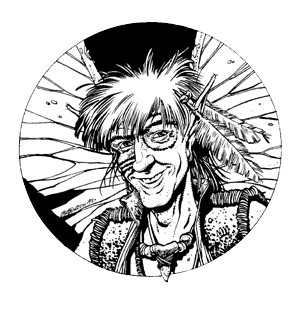
Obsidiman: Without a doubt the most unique race in a game known for unique races. Despite their name, obsidimen are genderless and formed rather than born. It's complicated, strange and not well explained - obsidimen have little interest in explaining something that no one else can really begin to conceptualize. This is just the tip of the iceberg on why I consider them a roleplaying challenge, to put it lightly. What makes them so interesting is also their greatest weakness: they are so alien, so different, that it is hard to come to terms with what their motivations are. The Liferock is the beginning and end of their existence. It is where they emerge from and return to, melding their memories with those of their brothers. They exist outside of the Liferock for 800 to 900 years, after which they return and don't leave anymore, becoming a more-or-less permanent part of the gestalt consciousness. They truly exist in a different way than the rest of the Namegivers and that can make them hard to integrate. However, they can also be very compelling, often stoic characters when they work.

Ork: Another interesting take on a classic fantasy race, also one that shows some of the connections to Shadowrun. Orks occupy some interesting creative space. They are often portrayed as villains - ork raiders, especially the dreaded cavalry Scorchers, are a plague across the land to the people trying to rebuild. In addition, they represent a significant underclass; once a slave race that won freedom and created a kingdom. However it was lost prior to the Scourge in a pointless war. Though the victory over them was Pyrrhic as the opposing kingdom fell during the Scourge. There are also those that are dedicated to ending slavery in all forms and bringing justice, as well as those that seek to reclaim and rebuild their lost glory and pride. As the second most plentiful race, and would likely be the first if they didn't die from violence so often, their stories are likely involve prejudice and working against a system that doesn't seem to want them. Indeed, the entire storyline of Cara Fahd (the ancient ork kingdom) can be particularly moving and tragic.

T'skrang: Easily the most popular race from Earthdawn, the t'skrang are flamboyant matriarchal lizard people that have a nearly unmatched exuberance for life. Flashy in dress and behavior, I have never had a group that did not include a t'skrang and it is not hard to see why - they are just fun. Most of their society exists along the major rivers where they control the trade in family merchant houses. The various houses exist in fierce competition with each other and it is not uncommon for conflict to breakout between rival crews on the riverboats.

Troll: There are two groups of trolls within Barsaive, the highland and the lowland. The lowland trolls are those that have integrated into society at large, though still maintain many of the same traditions. Highland trolls are who most of the stories are told. Living high in the peaks, they raid across the land in their airships and with crystal weapons; high fantasy vikings. No matter where they call home, trolls are all honorable and proud and it is wise to not forget that fact. At around nine feet tall, that is a lot of troll to have angry at you. Trolls are another very popular Namegiver for reasons that should be obvious and I can count the number of games I have run that did not include a troll on one finger.

Windling: An example of how many of the default assumptions which most fantasy world exist on are not quite the same for Earthdawn. Windlings are 18 inches and can fly, which presents some unique capabilities for any group to have access. It is easily to equate them to halflings or kender, though not entirely accurate. They are curious about everything and come from very tight-knit communities that share everything; life is rough when you're under two feet tall. This means that they are also absolutely fierce protectors of those they would consider family (including most friends) and rarely think only of themselves. They have some rather unique connections to the world, not the least of which is a natural ability to perceive astral space. Something to be aware of are windling spellcasters. All of the disadvantages windlings have are based around size and strength, receiving compensation in defenses and amazing access to Karma. For a spellcaster, these disadvantages are not disadvantages at all, and the ability to fly means that most dangers are trivial to avoid. I have found that it can be a potentially disruptive character. On the other hand, there is a windling-only melee Discipline, the Windmaster, that capitalizes on the strengths of windlings to make a truly dangerous tiny fighter.
Onto a related topic that highlights another part of Earthdawn that I enjoy. Names are an intrinsic piece of the magic that pervades the setting and system. One of the more subtle, but powerful aspects of Earthdawn. The importance placed on Names can be seen throughout the game and you will interact with them, but as you grow in power their place and importance will become more prominent in ways that I don't necessarily want to spoil right away.
 Within the world of Earthdawn, only Namegivers can grant Names through their actions. This is one of the things, perhaps the most significant thing, that makes Namegivers special; Names are powerful. Everything with a True Pattern has a Name, and vice versa. Once something has a Name it becomes alive in a way, it has transcended simply being a place or an object and gained the ability to affect its own fate. This will not necessarily manifest in any particular fashion, but the more powerful the Name, the more events will bend around it.
It is important to note that despite how powerful Horrors are, they are not Namegivers. They can receive Names through interactions with Namegivers, which is a terrifying thing. A Named Horror has a malevolence that transcends and they begin to define their existence through their deeds. There is a danger in Naming things, however once a Horror has a Name, it also becomes an individual with eccentricities and weaknesses. Through preparation, a Group can take advantage of this and they will certainly need all of the help they can get.
Within the world of Earthdawn, only Namegivers can grant Names through their actions. This is one of the things, perhaps the most significant thing, that makes Namegivers special; Names are powerful. Everything with a True Pattern has a Name, and vice versa. Once something has a Name it becomes alive in a way, it has transcended simply being a place or an object and gained the ability to affect its own fate. This will not necessarily manifest in any particular fashion, but the more powerful the Name, the more events will bend around it.
It is important to note that despite how powerful Horrors are, they are not Namegivers. They can receive Names through interactions with Namegivers, which is a terrifying thing. A Named Horror has a malevolence that transcends and they begin to define their existence through their deeds. There is a danger in Naming things, however once a Horror has a Name, it also becomes an individual with eccentricities and weaknesses. Through preparation, a Group can take advantage of this and they will certainly need all of the help they can get.
 Changing a Name will inherently change the Pattern and it will never be the same. A Namegiver that does this will lose all of the Threads Woven to their Pattern, and will begin to lose all connection to their old life. Objects and places undergo a similar process, though require access to a major part of the Pattern, and this decision should never be undertaken lightly. Certainly the elves know that well, and what was once Wyrm Wood stands as a continual cautionary tale of hubris for all.